Blog / Observability
What is Marketing Observability?
Produced by
Amar Tejaswi
Published
May 13, 2026
Last updated
May 21, 2026
Marketing has always generated data. But for the longest time, nobody built the infrastructure to actually watch it.
Engineers have real-time observability into every system they run. Marketing teams have dashboards they check on Mondays. Marketing observability, the practice of continuously monitoring your funnel the way engineers monitor their systems, barely exists as a concept, let alone a product.
That gap is what Marcenta is built to close. And this blog is where we document the thinking behind it.
If you are reading this in 2027, we would be very happy because it would mean we survived and did something right.
What really is marketing observability?
Well, I hope this blog defines what marketing observability is because there is almost nothing out there about it.
You could ask ChatGPT or Claude and either of them will likely ham up some definition, but it won't be grounded in practice.
Marketing observability is about ascertaining the health of not just the infrastructure but, more importantly, the marketing funnel. And that can still be done well using the data marketing programs generate on a daily basis.
In practical terms, marketing observability means automatically detecting funnel regressions, diagnosing what caused them, and helping teams respond before pipeline is affected.
In software systems, observability works cleanly because engineering is highly objective. You define a system with its intended behavior and if it deviates, you fix it.
Contrast that with marketing. You write a blog expecting it to rank in the top three positions and a week later it is sitting on page four, gathering dust. You launch a Google Ads campaign expecting leads and it burns budget without converting.
Marketing systems rarely behave as expected because there is a high degree of subjectivity. But data is still generated constantly.
The funnel is the most important thing in marketing. Everything we do in demand generation exists to generate leads, pipeline, and revenue.
Observability means knowing the state of that funnel at all times, without having to go looking for problems yourself.
Is marketing observability the same as marketing monitoring?
This is a critical question.
The classical definition: monitoring tells you when a system is broken. Observability goes further and tells you what broke and why.
Marketing teams have relied on dashboards and reports for years to understand what is happening with their funnels. Is that monitoring?
Yes and no. Yes, if you know what is likely to break and you are actively watching those parts of the funnel. No, if there are other areas equally likely to be disrupted that you are not watching.
Critically, the differentiator is reactive versus proactive. Both monitoring and observability are proactive by nature. Dashboards and reports are reactive, even when they stay updated with live data.
A monitoring or observability system should tell you when something is wrong. Not the other way around where you are digging through data to find anomalies yourself.
So in that sense, I could boldly claim that most marketing teams don't have observability set up. Most don't even have monitoring. They have dashboards.
Types of observability in marketing
Marketing has two distinct components and observability applies differently to each.
Infrastructure
Marketing infrastructure is the objective layer. CMS, tracking pixels, forms, website performance. Engineering teams build and maintain it.
It rarely breaks, but when it does the impact is significant. Page speed across geographies, form submission rates, pixel firing accuracy. These behave like software systems because they essentially are software systems, and they need continuous monitoring.
If you search 'marketing observability' today, one of the only results is a New Relic article on the topic. What they describe is infrastructure observability. It is real and worth doing, but most tools stop here. And that is exactly the gap nobody has filled.
Marketing programs
This is where most teams are flying blind.
You could have flawless infrastructure and still be losing pipeline because a campaign is underperforming, a keyword is slipping, or a conversion rate quietly dropped two weeks ago and nobody caught it.
Program observability is continuous visibility into what is regressing and what is improving across your entire marketing funnel. Paid, organic, CRM, every channel. Some people call this funnel observability. We think it is the only kind that actually moves the needle.
Detecting regressions automatically and diagnosing root causes is what completes the observability loop. This is the harder problem, and the one that is largely unsolved.
Why marketing observability matters now
As we move into the prime of the AI age, marketing is becoming more about speed than anything else. Teams that move fast and optimize at equal speed will win.
But optimizing quickly requires knowing what to fix and when.
Here is a scenario that plays out at most marketing teams. Your LinkedIn CPL doubles over four days. Nobody notices because the aggregate weekly numbers look acceptable. By the time someone pulls the campaign report at the end of the month, you have burned three weeks of budget at twice the cost.
The problem was visible in the data from day one. There was just nobody watching.
That is the gap observability fills. A typical marketing campaign has dozens of moving parts. Impressions, CTR, conversion rates, CPL, keyword positions, audience overlap. Any one of which can derail performance silently.
If someone has to manually audit all of it, you sacrifice the speed that matters. The system should be watching so your team does not have to.
Key ingredients of marketing observability
Not every system that surfaces marketing data qualifies as observability. The loop looks like this:
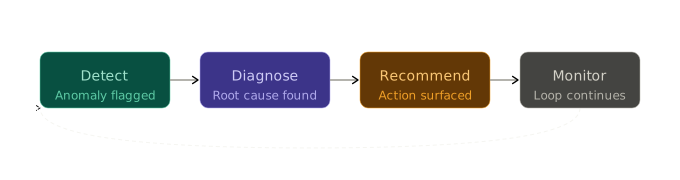
Here is what we think the real ingredients are.
Proactive by design
The user should not have to spend time defining what to monitor before getting value.
A good marketing observability system works intelligently by default, without requiring exhaustive manual setup. If you are spending hours configuring alerts before you see a single insight, something is wrong with the tool, not with your funnel.
Visibility at every level
Top-level metrics are not enough.
A drop in overall traffic tells you almost nothing on its own. You need to know which channel, which geography, which campaign, which device.
Observability requires depth. Monitoring the granular dimensions underneath every aggregate number, not just the aggregate itself.
Dynamic baselines, not hard thresholds
This is where most attempts fall apart.
A static rule like flagging anything that drops more than 20% sounds reasonable until you realize it generates constant noise for a company with naturally volatile data and misses real problems for one with stable baselines. A startup and an enterprise cannot share the same thresholds.
Good observability builds baselines from each company's own historical data and flags only deviations that are genuinely abnormal for that specific funnel. The system adapts to you, not the other way around.
Intelligent triage
On any given day, dozens of metrics will move. Most of them do not matter.
A good observability system triages incidents by severity and business impact so your team sees the two or three things that actually need attention. Not a wall of alerts that trains them to stop looking.
Root cause analysis
Detection without explanation is half a job.
Once an incident is flagged, the system needs to go deeper. Cross-referencing correlated signals, segmenting by dimension, pulling historical context. To answer not just what happened but why.
That is what closes the observability loop and separates genuine observability from glorified alerting.
The complexity of marketing observability
It is worth being honest about how hard this is to build well.
The core problem is that marketing data is not uniform. Traffic is a useful metric, but a drop in traffic to your pricing page is a completely different event from a drop in traffic to a three-year-old blog post. Both are traffic metrics. Only one should trigger an incident.
The same asymmetry exists everywhere. Some campaigns run large budgets with high natural variance, where a 15% swing is just noise. Others are small tests where a 10% move is a real signal. Some pages are conversion-critical. Others are informational.
The same percentage change carries completely different weight depending on context, and no static rule can account for that across every company's unique setup.
The same metric can be noise for one company and a five-alarm fire for another. That is the core challenge of marketing observability.
This is why noise is the real enemy of marketing anomaly detection. A system that alerts too aggressively trains teams to ignore it. A system that is too conservative misses what matters.
Getting that balance right, dynamically, at scale, across every metric and every company, is the genuinely hard part of building this well.
Marcenta AI and marketing observability
We think we are one of the first to attempt this seriously. Here is what we have built so far.
Marcenta monitors every metric across every connected source automatically. Minimal configuration and no hard thresholds to maintain.
Baselines are built from your own historical data using statistical methods that adapt to your funnel's normal behavior.
When a genuine anomaly surfaces, an AI agent investigates immediately. It correlates signals across channels, segments by dimension, and produces a root cause finding before you even open the alert.
Here is what that looks like in practice. LinkedIn CPL spikes on day one. The agent identifies audience fatigue in the EMEA segment, correlates falling CTR with rising CPC across the last seven days, and recommends pausing the underperforming audience segment. That finding is ready before anyone on your team has opened a dashboard.
Low and medium severity incidents are monitored autonomously until they resolve or escalate. High severity incidents come to your team with the investigation already done.
Detection, investigation, autonomous monitoring. That is the loop.